
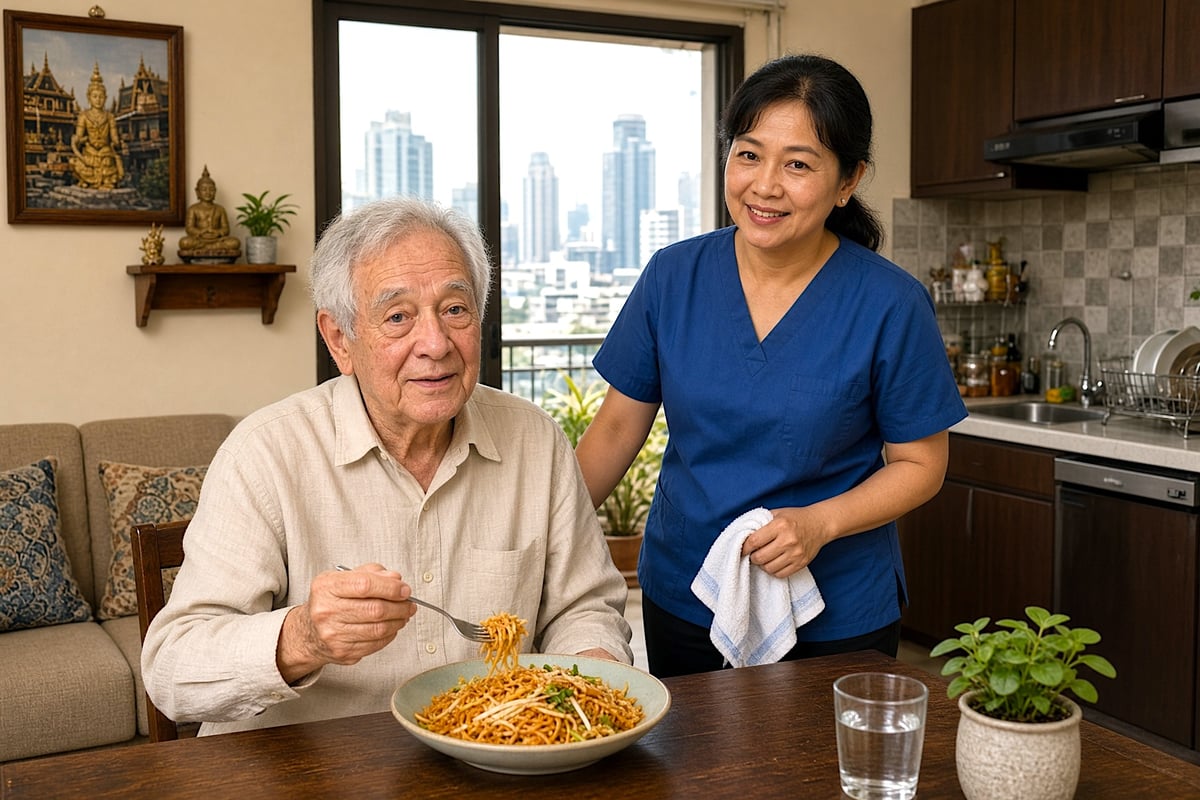
Memory care without leaving home
When you first hear the words memory care, you may picture a locked floor in a facility, a shared room, and a parent far from everything they know. There is another way. Memory care at home brings the same trained, patient support into your own apartment or house in Thailand, so your loved one keeps their bed, their kitchen, and their view while still getting the supervision dementia calls for.
ElderThai provides this care as a registered care business rather than a medical centre. Your caregiver handles the daily realities of living with memory loss, and a Nurse Coordinator designs and reviews the plan, so the help is structured without ever feeling clinical.
Why familiar surroundings matter so much
Memory loss makes new places frightening. A person who cannot reliably form fresh memories has to relearn an unfamiliar building every single morning, which fuels the confusion and agitation that facilities then try to manage. Home avoids that problem entirely. The hallway to the bathroom is already mapped in muscle memory, the smell of the kitchen is reassuring, and the chair your father always sits in still holds the shape of him.
That sense of place does real work. When the surroundings stay constant, your loved one spends less energy on fear and more on the small pleasures that still land, whether that is a familiar dish, a grandchild's visit, or the afternoon light through the same window.
Home memory care compared with a facility
A facility offers shift staff and a building designed for the condition, and for some families that is the right answer. But at-home memory care offers things a facility structurally cannot:
- One or two consistent caregivers who truly know your loved one, instead of rotating staff
- A pace set by your parent's day rather than the building's schedule
- Familiar food, familiar bed, and family who can visit on their own terms
- Care that scales to your loved one alone, not divided across a ward
The deciding question is rarely which option is better in the abstract. It is which one keeps your particular parent calmest, and for many people that is the home they already love.
How at-home memory care works day to day
A memory-care day is built on gentle structure. Your caregiver arrives and picks up the established rhythm, guiding washing and dressing with quiet prompts, keeping meals at steady times, and weaving in activity that suits your loved one's stage and mood. Nothing is rushed, and nothing is forced. The goal is a day that flows so smoothly your parent rarely notices how much support is holding it together.
Throughout, the caregiver watches for the signals that matter, from a dip in appetite to a new reluctance at bath time, and reports back so the Nurse Coordinator can adjust. The plan stays a living document rather than a form filed away on day one.
Common situations we help with
Getting lost in a familiar home
Even at home, memory loss can blur which door leads where, and your parent may stand puzzled in their own hallway. Your caregiver offers a calm cue and a steady arm, turning a moment of panic into a quiet redirection without drawing attention to the slip.
Forgetting whether meals have happened
Your loved one may insist they have not eaten all day, or skip food entirely because hunger no longer registers clearly. Caregivers keep meals on a dependable schedule and make eating inviting, so nutrition stays steady regardless of what memory reports.
Mixing up family and timelines
Your mother might greet you as her own sister or ask after people long gone. Rather than correct her, your caregiver meets her where she is, easing the conversation toward comfort instead of confronting her with a loss she would only have to grieve again.
Restlessness with nowhere to put it
Memory loss often comes with an urge to do something without knowing what. A caregiver channels that energy into simple, satisfying tasks like folding, sorting, or a short walk, so the restlessness settles instead of building into distress.
Care that grows with your loved one
Memory needs rarely hold still. You might begin with a caregiver for part of the day and find, over time, that evenings or nights need cover too. Because the same team and the same Nurse Coordinator stay involved, those changes happen smoothly. If round-the-clock presence becomes the priority, you can move toward live-in dementia care, and if you are weighing the wider options, our overview of Alzheimer's and dementia caregiving is a good place to start.
Start care at home
Choosing memory care does not have to mean choosing a facility. With a few details about your loved one's routine and what currently worries you, a trained caregiver and a Nurse Coordinator can shape support that fits your home in Thailand. When you are ready, your family can start care at home.
Where You Can Get Care
Elder Thai has caregivers in Bangkok, Nonthaburi, Phuket, Chiang Mai and Pattaya. Tell us where you are when you book and your care is arranged there.
This service starts from 2,200 THB per visit.
See full packages and pricing